I watched someone fall out of the sky and not come back
MASTERCLASS for paid subscribers: finding the strength in post traumatic growth

as seen on:










I watched someone fall out of the sky and not come back.
It was a drop zone in Franklin, North Carolina. I'd met her briefly: her name was Sharon, and her daughter shared my name.
We stood on the side of the runway waiting for the plane in the thick hot air of that North Carolina day watching the jumpers exit the plane, do relative work in the sky. One of the tiny bodies reached for the pilot chute, reached again-- but the chute never opened, the reserve never opened, and then-- the jumper was gone.
The plane landed, turned around and taxied up to those of us waiting on the tarmac. We got back on the plane, and at 13,500 feet, we jumped.
I don’t have clean words for what that moment feels like. The sound. The silence after. The way everyone on the ground just... stopped.
And then we got back on the plane.
Not because we were callous. Not because we were reckless. But because in that world, you learn something most people spend their whole lives avoiding:
Death is not a reason to stop living. It’s a reason to be intentional about how you do.
Psychologists Richard Tedeschi and Lawrence Calhoun spent decades studying what happens to people after they encounter the kind of experience that shatters their assumptions about the world. They called it Post-Traumatic Growth — the experience of positive change that occurs as a result of the struggle with highly challenging life crises, manifested in increased appreciation for life, more meaningful relationships, an increased sense of personal strength, changed priorities, and a richer existential life. (ResearchGate)
Notice what they didn’t say. They didn’t say the trauma goes away. They didn’t say it stops being terrible.
They said that the struggle with it is where the growth lives.
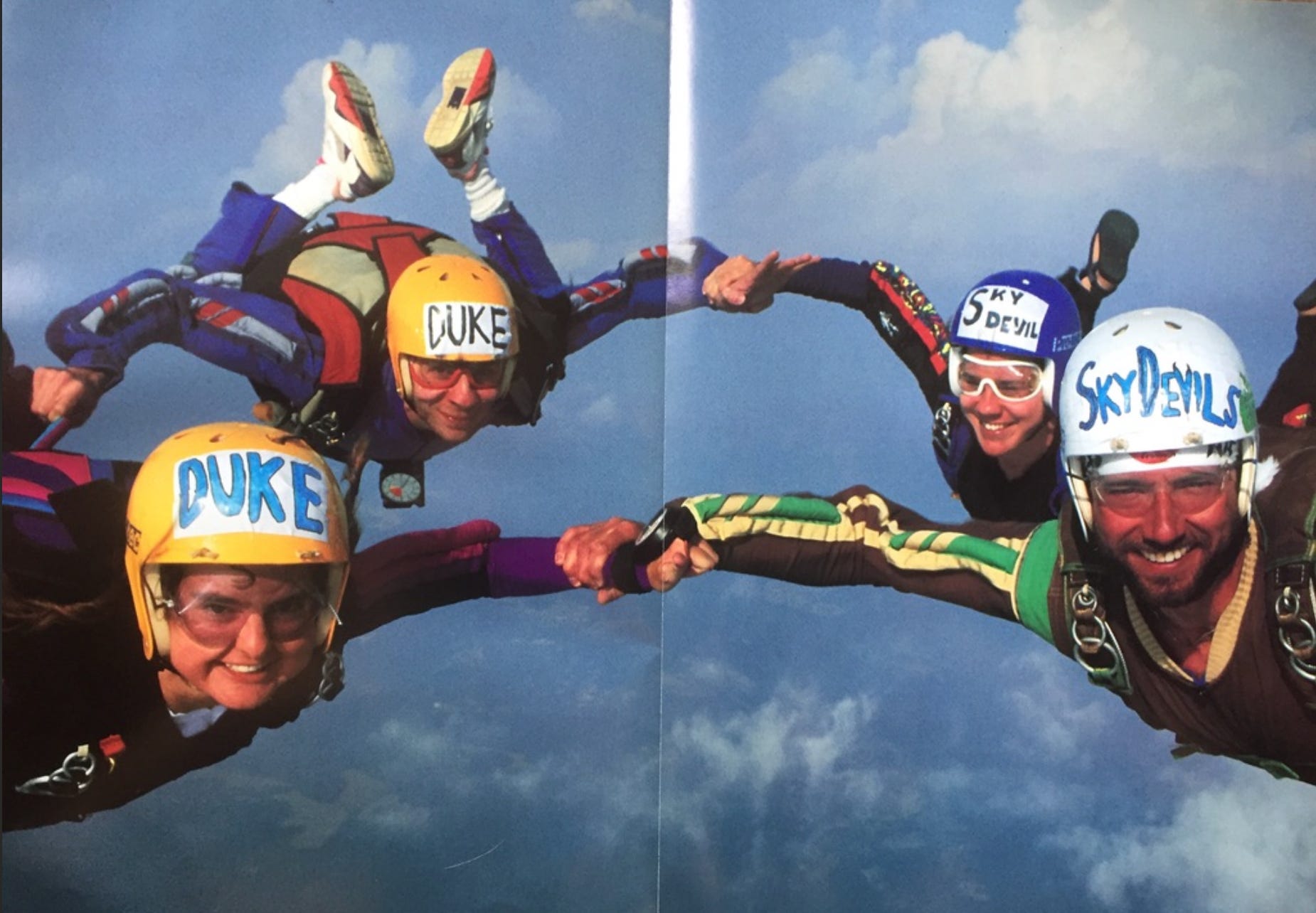
Duke SkyDevils c 1993. I’m in the blue helmet.
I work with senior leaders. CEOs, C-suite executives, founders who’ve built something real— all people who, from the outside, look like they have it figured out.
And behind closed doors, many of them are reckoning with questions they don’t say out loud in boardrooms:
Is what I’m doing actually meaningful — or just impressive?
Have I become so focused on the organization’s survival that I’ve lost sight of my own purpose?
When this chapter ends, what will I have actually stood for?
Am I leading from conviction — or from fear of losing what I’ve built?
The questions senior leaders, and the rest of us, must confront in our own drop zone moments aren’t signs of weakness. They are the exact questions that Tedeschi and Calhoun’s research tells us trauma — and the honest confrontation with mortality — forces us to finally ask. if we are willing to do the work, confronting a traumatic event and trying to make sense of it can lead to powerful shifts in thinking about ourselves, our relationships, and the world. (ProjectManager)
Most senior leaders have had their version of a drop zone moment. A near miss. A sudden loss. A diagnosis. A failure that leveled them. The question isn’t whether those moments happened. It’s whether they did anything with them.
Getting back on that plane after what I witnessed was one of the hardest things I’ve ever done. But I knew that fear left unchallenged doesn’t stay in one place — it spreads into every decision, every relationship, every choice about how you lead and how you live.
Here’s what that day — and the research — tells me about leaders who grow through rather than around their hardest moments:
They let it change their priorities, not just their perspective. PTG isn’t a feeling. It’s a reorientation. The leaders I most respect didn’t just survive their defining crisis — they let it fundamentally reorganize what they were willing to spend their one life on.
They forge deeper relationships as a result. Survivors of trauma forge stronger relationships with loved ones as well as with those who suffered in the same way. (ProjectManager ) The leaders who have been through something real lead with a different quality of presence. They’re less transactional. More human. People feel it.
They discover a personal strength they didn’t know they had. Not because it was easy — but precisely because it wasn’t. The knowledge that you have faced the unsurvivable and survived it changes how you walk into every room afterward.
But I also knew — the way you know things at altitude that you forget at sea level — that if I didn’t go back up that day, I might never go back up again. And that fear, left unchallenged, doesn’t stay in one place. It spreads— into your decisions, your leadership, the culture of every team you touch.
Here’s what that day permanently changed in me — and how these ideas impact the leaders I work with:
Mortality is the ultimate clarifying force. When senior leaders finally sit with the reality that their time is finite — not conceptually, but viscerally — something shifts. The performative falls away. What remains is what actually matters to them. That’s not a crisis. That’s the beginning of their most authentic leadership.
The higher you climb, the easier it is to confuse altitude with purpose. Titles, authority, compensation — these are not answers to the existential questions. I’ve sat with leaders who have everything the world says should be enough, and they are quietly starving for meaning. Acknowledging that isn’t failure. It’s honesty. And honesty is where real leadership begins.
Fear at the top is lonelier than fear anywhere else. Senior leaders are rarely allowed to be afraid. So the fear goes underground — and starts driving decisions no one can quite explain. Getting back on the plane, for the leaders I counsel, often means naming what they’re actually afraid of. Not the market. Not the board. The deeper things. Am I enough? Did I choose the right life? Is it too late to lead differently?
It is never too late. But it does require getting back on the plane.
That jumper I barely knew didn’t get another day to wrestle with those questions. I think about that every time a leader tells me they’ll do the deeper work “when things settle down.”
Things don’t settle down. You just get more practiced at staying busy.
This is not a rehearsal.
The legacy conversation you keep deferring. The values you’ve compromised incrementally. The leader you always intended to become. None of it is guaranteed a tomorrow.
Get back on the plane.
If you knew your chapter in this role ended tomorrow — what would you most wish you’d done differently, or said out loud? What would you want to be your legacy?
PS:
Reading: The Diary of a Country Priest, by Georges Bernanos,
Listening to: Ezra Klein about Epstein, Mel Robbins on legacy.
Watching (or listening!) my conversation with Merryl Tengesdal, the first and only Black woman to fly the U2, for Black History Month or anytime— she has ideas on getting unstuck for all of us. Olympics Hockey, figure skating, nordic skiing, alpine skiing
Thank you again for being a paid subscriber!
The worksheet for this post is attached.




Apple | Spotify | Amazon | YouTube
Become the person who shows up stronger, clearer, and more purposeful — no matter the challenge.
Transform your leadership, decision-making, and personal resilience for stronger, more purposeful leadership and resilience organizations.