Staying human in an age of political turmoil, education and technology
Recommendations to watch, read, and listen.
as seen on:









I’m booking keynotes for 2026-27. Reach out if I can bring The Grit Factor to your organization!
In the time since the last newsletter, our country has convulsed around the murder of a protestor in Minneapolis by poorly trained federal agents. The people of Minnesota have pushed back, despite the sub-zero temperatures. And every day we hear of the massive global changes that are imminent— wars, new world orders, AI— and less imminent but just as certain— population collapse, and it is easy for some to find the endtimes in their speech. I encourage us to resist the temptation of despair and move forward demanding our human best.
The challenge for our nation is symptomatic of other changes— which though different, are at least tangentially connected and have similar solutions. In my work with leaders, the challenge looks like balancing the mad rush to new technology— now AI— with keeping focus on the most important part of any business— our people— and our humanity.
A recent interview with the controversial Marc Andreessen prompted additional thinking on this. Andreessen is homeschooling his ten year old, with a very different focus than our family has on education. In the interview, he offers ideas about AI in education which I find misplaced and riddled with the same dangers a thoughtful leader in any industry should handle with extreme caution, to wit: protecting the work of being human.
Andreessen mentions the long understood best practice— in a population of one— of finding a 1:1 tutor to work with kids on their learning, the practice for centuries for those who could afford it. This isn’t possible for the general population, of course, so Andreessen suggests this could be a role for AI. What if every kid had his or her own individual AI tutor? How much more equal the world could be? He references Alpha Schools which are using this approach with apparent success.
This past fall I had the chance to be deeply engaged in a middle school classroom, and from that experience and others (as well as being the parent to two teenagers), I’m going to suggest this concept is not well considered. Can a kid learn through AI? Absolutely— at least they can learn something, a discrete skill or idea. WILL a kid learn through AI? Only if said kid wants to. Will they learn as well as a child will learn with the attentiveness of a teacher? They absolutely and categorically will not. (the most recent Economist joins the explosion of studies on the utter failure of Ed Tech.)
In the classroom where I’ve spent time, they’ve included some adaptive (AI) learning with workbooks, workshops and real world practice. The adaptive learning is a tool, but not primary.
Three years ago our family participated in a service trip to Morocco through IVHQ. We lived with a family in the medina, and in the mornings worked at a creche (preschool) in the city of Rabat. The modest home where we stayed, sleeping in shallow cubbies off the main living area behind lace curtains, and sharing the tiny closet that served as both toilet and shower with the household, itself opened our eyes. Our hosts invited their grandsons, similar ages to our two boys, to come and stay while we were there; watching the boys all kick a soccer ball down the narrow streets in the medina was extraordinary, the crossing of a cultural and language barrier that otherwise would have seemed impenetrable (Messi, it turns out, has intercultural appeal).
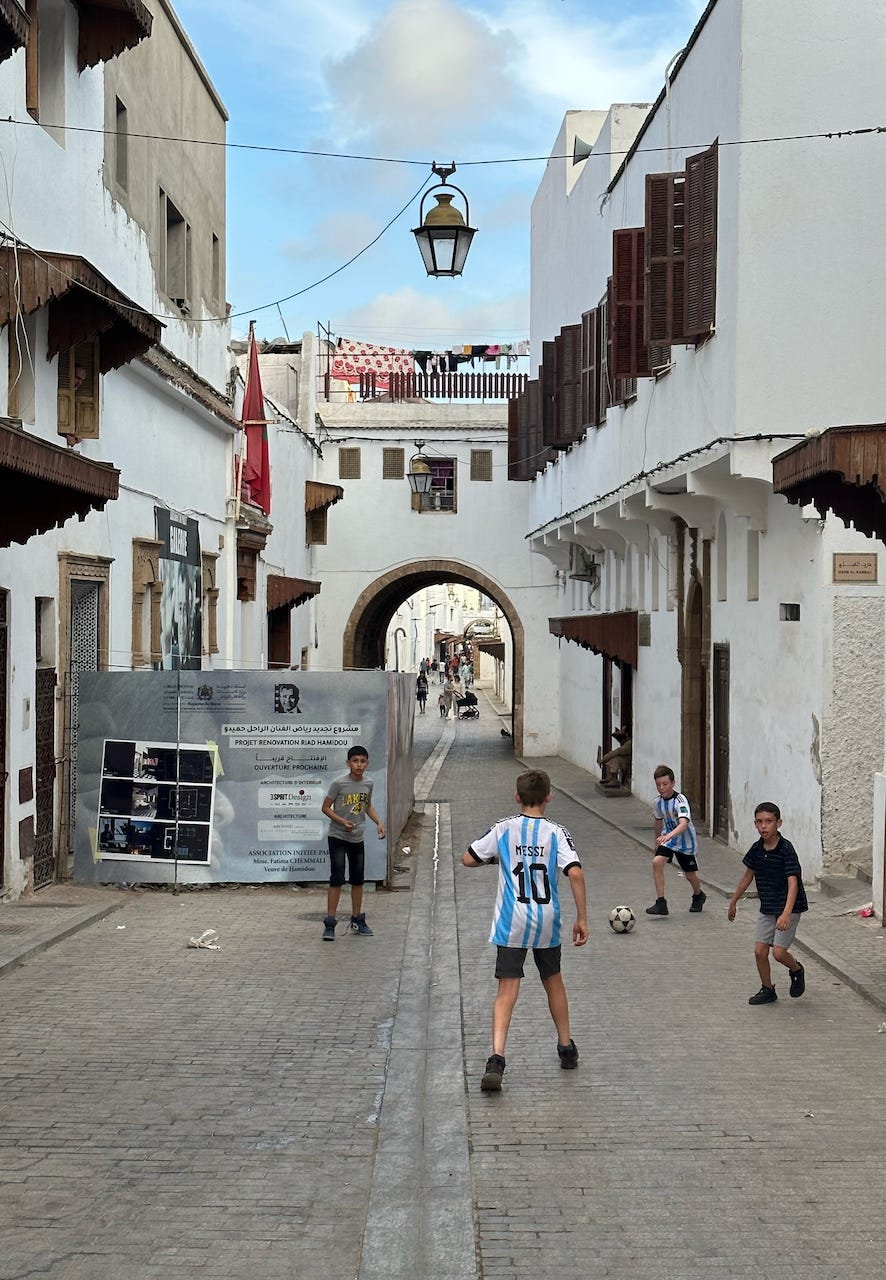
What struck me though— the thing which relates to the thesis of this newsletter— was this: everybody had cell phones. There were no books in sight. And the boys, who loved kicking the ball together, were not reading or playing board games when they were inside. They were playing video games.
Cell phones and technology were supposed to revolutionize and make accessible education around the world. They have certainly become ubiquitous, but unless a person chooses— and has the immense presence of mind and discipline to avoid the addictive elements of these tools— the tools of technology simply hold people hostage in new ways. AI will be the same.
If a person is able to cut through the noise and the temptations and learn to use the tool, there will be tremendous possibility, though the greater the power, the greater the temptation— Frodo taught us that. If not, the tool will be another agent of suppression. Having teenaged boys (and realizing I am also subject to these same pulls), I’d suggest the ability of most to stay focused on utility over entertainment has likely always been low, and after the onslaught of technology in and our of classrooms, today it’s lower than ever (while the tools are more powerful and addicting than ever.)
This is a tangential statement on education as well as technology in service to the greater question: we must remain human— but human at our best. We must see ourselves as accountable to this humanity. Kids learn best from another human— studies show this in language, especially at younger ages. It is our ability to be in relationship that is particularly human. What interferes with that relationship makes us sick— mentally, socially, spiritually. (mental illness statistics, spiritual statistics, loneliness statistics).
At work, we should focus on our humanity— while acknowledging and managing the tools we use. This is the most critical component to doing good work, collectively. The French word for together is “ensemble”— which calls to mind a group of string musicians, playing together, listening to the subtle tonal and rhythmic shifts around them, playing in concert, adjusting to the work of each of the other musicians. This subtlety, this interplay, this art— this is the work of people, and the work of humanity. As anyone who has played in an ensemble knows, there are a lot of wrong notes, a lot of dissonance, and painful and tedious cacophony that comes in the weeks and months before the final performance. And even at the concert, if you know the piece well, even a beautiful performance is very rarely perfect.
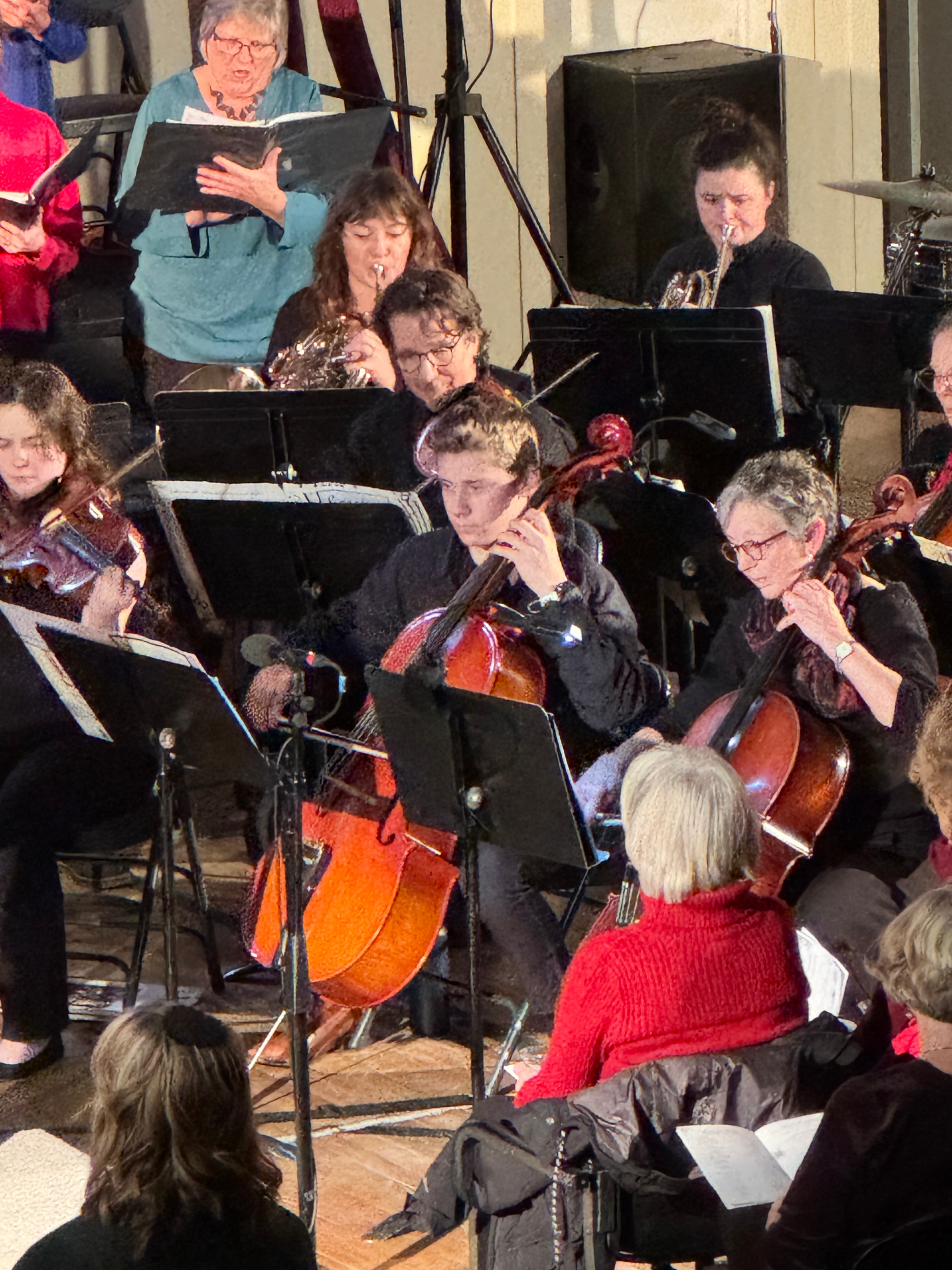
Our son playing the cello with our local orchestra and chorale
In Minneapolis and in politics, as with work and school, our work is also to be human. Accountability must be politically neutral. Criminals should face justice— this is not in question. And our government must both follow and enforce the rule of law— at all levels and in all situations. Moreover, the way in which the law is enforced should reflect the values of decency and respect. Citizens are protected under the Constitution— this is the music which we are meant to play. Legal immigrants are also protected.
It is our ability to be in relationship that is particularly human.
The gift of our humanity is a unique combination of body and heart, mind and spirit. Our minds must be logical and impartial, curious, critical and questioning. Our hearts should be loving. Our spirits must be merciful. And when our government does not represent the best of us, we should stand in the streets with the people Minneapolis, and demand better, and we vote for better, and we work for better.
Whether in our schools or our workplaces, our cities or our homes, the world and our nation(s)— plural for any of you reading from other part of the world— need our best. We need each other’s best— each other’s fully human, thinking, loving and blessing— best. That human best may use any number of tools for various tasks— but whatever the tools, they must be, at the core, reflective and inclusive of whatever is best about humanity, and not interfere in what makes us who we are. If our institutions fail us, each of us has the opportunity to do the hard work to bring back these values in our lives and work one action at a time.
Of course, when we are honest, humanity is also what is worst about us— that’s where we started out today— that is the conversation about values and accountability we will come back to again and again.
If we are at our human best, what does that mean for you in the office and beyond?
What are your own values, and what are the values of your organization? How can you bring those more into your work each day?
How are you prioritizing what is best in your people today? How are you investing in them? Send me a note to bring leadership development from The Grit Institute to your organization.
What I’m watching: Artemis II launch videos at NASA.gov Launch is delayed until March, but we are excited! And Grantchester, the new British murder mystery on Netflix.
What I’m reading: Rise Above, by Scott Barry Kaufmann, Prayer in the Night, by Tish Warren Harrison
What I’m listening to:
Podcasts: The Knowledge Project, Everyday Ethics (BBC), The Journal, Old School, News in Slow French
Music: Over the Rhine— I’m late to the show on this, but grateful to have so much to catch up on. A truly wonderful, soulful, deeply human and stunningly beautiful folk band coming from the heartland in the U.S.
Classical Choral music: William Harris’ stunning setting of the John Donne poem “Bring us O Lord God,” here sung by VOCES8
PS: Technical difficulties impacted the recent Masterclass on Mindset- stay tuned for another opportunity!
Apple | Spotify | Amazon | YouTube
Become the person who shows up stronger, clearer, and more purposeful — no matter the challenge.
Transform your leadership, decision-making, and personal resilience for stronger, more purposeful leadership and resilience organizations.