
The Astronaut Standard
Embodied leadership makes all the difference, and #amreading #amlistening #amwatching

as seen on:










This past week, away with my son on spring break, we spent an hour in the hotel gym watching the Artemis II splashdown, and then ran to our room to continue watching the recovery. We could not get enough of it, and we seem to be in good company. We know their names by now: Christina, Reid, Victor, Jeremy. They could be our neighbors, even our friends.
What is it that we need so badly from this crew of four (and the thousands who supported them)?
These four astronauts— and the phenomenal effort of thousands on earth— represented decades of preparation. They did something nobody has done before, or even approached in fifty years. And with the current political climate’s arrogant dismissal of what is possible from a more diverse crew, every member, black, white, male and female, demonstrated extraordinary performance. And they worked as a crew. On top of all of this, as well as being exceptional, some of the best in the world at what they do, every member of the crew is likable and humble to a fault. (after having a chance to spend a weekend with Victor and his family last year, I can confirm this is true in person as well).
Why do we need not only this mission, but the astronauts themselves?
Inspiration.
The mission alone is worthwhile. Scott Barry Kaufmann writes in Harvard Business Review that “inspiration awakens us to new possibilities by allowing us to transcend our ordinary experiences and limitations. Inspiration propels a person from apathy to possibility, and transforms the way we perceive our own capabilities.” In any climate, but especially in a climate of fear and change, we need this more than ever.
But the astronauts do more for us than a mission would be in an unmanned spacecraft. They show us the embodiment of excellence, the embodiment of audacity, the embodiment of decency, and for some, the embodiment of faith in a culture that so easily dismisses it.
Embodiment matters.
In a prior episode of The Grit Factor podcast, I had the opportunity to interview Killian Noe, the founder of the now national Recovery Cafes. In addition to innumerable powerful insights on community, accountability, and service, Noe offers a critical insight: She talked about pictures they keep on the wall at Recovery Cafe: Mother Theresa, Gandhi, Desmond Tutu, The Reverend Dr. Martin Luther King, Jr.
“We need to see things embodied,” she says. “You can talk about the practice of forgiveness all day long, but then you see a picture of Desmond Tutu, and you get it.”
This is why we need the astronauts, every one of them: Christina, Victor, Reid and Jeremy. This is why when we share our own stories, when I tell you: I struggled here and this is what happened— is a much more significant experience than sharing data or ideas about overcoming challenge.
Want to have the kind of conversations that help to develop these traits? Grab your copy of Family Dinners: 100 Conversations on the Good Life!
We can talk about values, and we can talk about what we are missing, and what we need to do, but to see it, to see it in others— then we can begin to see it in ourselves. Perhaps not climbing into a rocket ship— but beginning to be a little more brave, a little more committed, a little more kind.
Leadership
That’s why leadership by example, what we talked about in the Army as “leading from the front,” is so important.
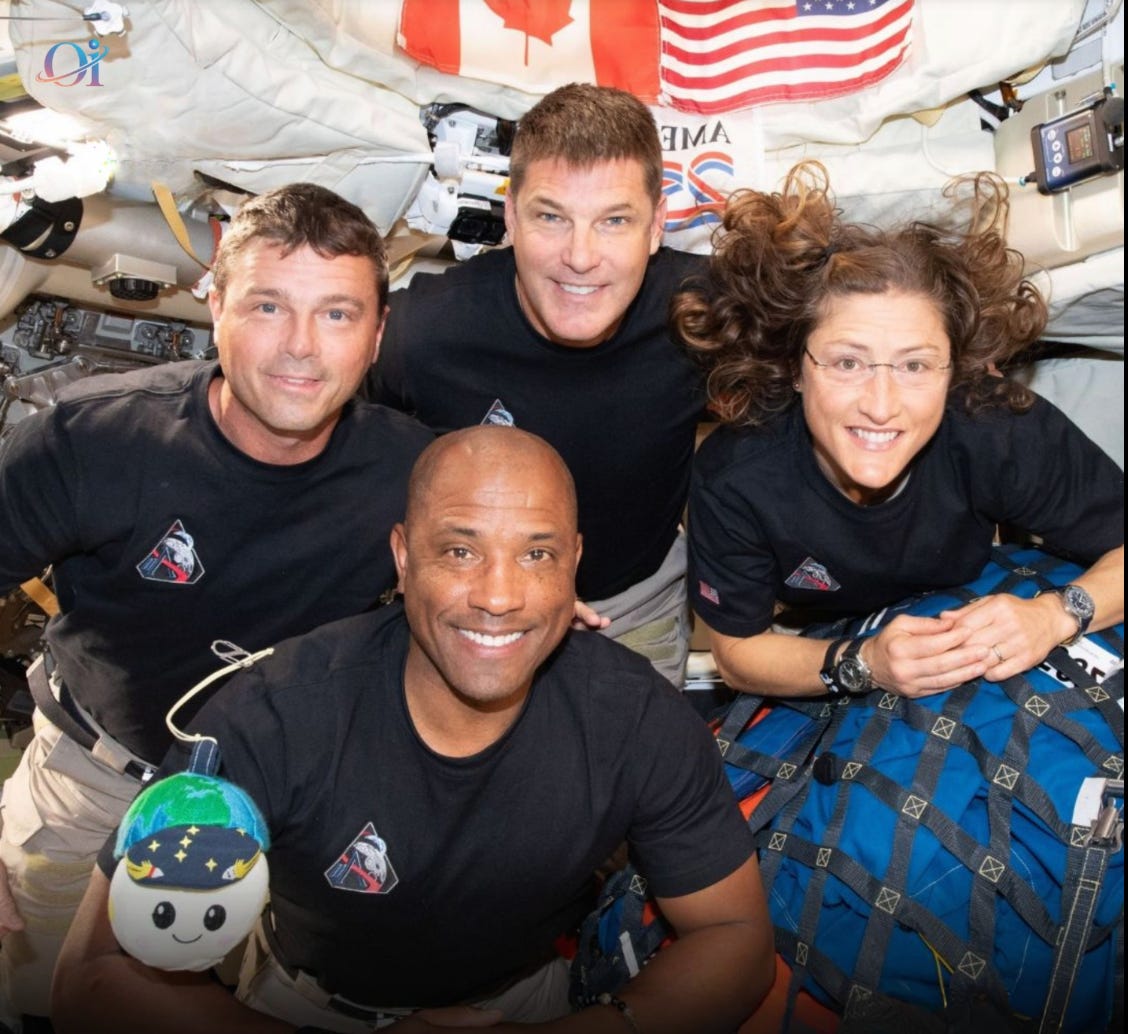
The four astronauts in Integrity embody the values I want in our children
There is something in human nature that looks for an example. We’re social creatures. Even a young child looks at the next oldest child to see how to act. Our professional settings are little different. I remember being surprised at how much there was a desire for a hero, even at Microsoft. More senior leaders were referred to by their email moniker, setting them apart, holding them up. We want, as a species, to see the examples of who it is that we can be. On our own, it's far too easy to doubt ourselves, and to refer instead of to what is aspirational, to how it is we must settle in our own work and lives.
And so setting the example in a meaningful way, connected to meaningful and lasting values, is critical. The next older kid or the senior leader at work may not offer that. These astronauts seem to give us exactly what we need at a time when our own country’s leadership cannot find its way out of the toilet, acts with craven disrespect and effrontery, and in nearly every action does not honor either dignity or respect in our fellow human being.
That kind of appalling behavior encourages other appalling behavior. Note the surge in sexually appalling language and phrases on social media after the 2024 election, as documented by the Institute for Strategic Dialogue. Or the Council of Foreign Relations measuring increases in calls for sexual violence once the election results were in.
Bad behavior rubs off. And when it doesn’t, it’s deeply discouraging to the point of apathy in some cases. But good behavior rubs off too. It uplifts. It inspires.
Caught. Sought. Taught.
This is part of the (truly excellent) framework for character development at the Jubilee Center at the University of Birmingham in the U.K. Character— whether in education, the public sphere or business, character should be “caught, sought and taught,” a reference to the “different ways in which professional virtues can be acquired, transmitted, and consolidated.” The catching comes from observing leaders and colleagues, and from the culture of a workplace (which is the possibly primary role of a leader to develop). Of course, as the statement on virtues in the professions notes, “It is also a key conviction that the more people exhibit good character and virtues, the healthier our society.” The ideal moral exemplars in a professional setting are “people who are already close to the moral learner, such as university tutors and workplace colleagues who serve as models for emulation.” Thus the importance of modeling excellent character as a leader.
Without the right modeling, character cannot be “caught.” The study warns specifically: “Much of professional ethics will be caught from the workplace environment and organizational culture. Practical wisdom will not be caught from a learning environment that is inimical to virtue development.”
Nobody, of course, is perfect. But looking up, quite literally in the case of Artemis II, to people who continue to do hard work without complaining, who speak to the challenges and opportunities in life, who embody what it means to do the work oneself and also to work as a crew with decency and respect, to “row together with purpose,” as Christina said, is the kind of example we so desperately need right now— and always. The Artemis II crew seemed to understand this. It was they who named their capsule Integrity.
There are many people who made the Artemis II mission the success, but the astronauts have been given the role of representing that effort. And even in those roles, they have not succumbed to the culture’s tendency toward self centeredness.
Legacy.
In an interview with Bill Whitaker of 60 Minutes in February, Christina Koch said that she hopes their mission is forgotten. She sees it as a part of the work toward exploration, toward learning more:
“I hope they forget all about Artemis II. We talk about our legacy being enabling the future missions.”
What if we lived into our purpose, and not into ourselves? What if we follow the leadership of these four brave people, and live with and into integrity? We need these traits embodied, and the crew of Artemis II gives us exactly that.
That’s a legacy for us all.
With love and to your grit factor,
Shannon
PS:
Want to have the kind of conversations that help to develop these traits? Grab your copy of Family Dinners: 100 Conversations on the Good Life!
#AMREADING What to Make of a Life, by Jim Collins
#AMLISTENING Cal Newport’s Deep Questions with Arthur Brooks, NYT The Daily on the Mississippi Schools (every other state, get on board, stat!)
#AMWATCHING All Creatures Great and Small on PBS with my youngest son. Absolutely stellar. And characters who embody values and virtues worth watching.



Apple | Spotify | Amazon | YouTube
Become the person who shows up stronger, clearer, and more purposeful — no matter the challenge.
Transform your leadership, decision-making, and personal resilience for stronger, more purposeful leadership and resilience organizations.